
The Familiar Things We Choose
How familiarity shapes the way we trust and choose brands.
I was driving back home from Zurich to Italy, where I come from.
The sky was grey, a bit like my mood that day 😅. The road stretched ahead, the landscape almost muted under the clouds.
Then, all of a sudden, as I reached the Riviera, the sky opened into an incredible sunset. It was absolutely stunning. The colors shifted from blue to yellow, then to a deep orange, and finally to a rich red that seemed to set the entire horizon on fire.
It was so beautiful that I actually stopped the car just to take it in properly.
And while I was standing there, looking at it, a strong sense of familiarity appeared.
It was not exactly a memory. It wasn’t something I could clearly place. It was more like a feeling that this moment somehow already belonged to me. I paused and found myself reflecting on that sensation.

The Psychology of Familiarity
Our brain is constantly scanning the environment, trying to determine one simple thing: is this safe or not? A small structure deep in the brain called the amygdala plays a key role in this process. It helps evaluate potential threats and triggers the fight-or-flight response when something feels uncertain or unfamiliar (LeDoux, 2000).
But when something feels familiar, the opposite happens: the brain relaxes.
Familiar stimuli require less effort to process. Processing fluencyrefers to the tendency for information that is easier for the brain to process to feel more truthful, more pleasant, and more trustworthy. In other words, familiarity creates cognitive ease and comfort.
Daniel Kahneman describes this dynamic in Thinking, Fast and Slow: when something is easy to process, we tend to interpret it as more credible and more reliable.
And then there is the mere exposure effect, which reinforces Kahneman’s theory. In a series of experiments conducted by psychologist Robert Zajonc in the 1960s, participants consistently preferred stimuli they had seen multiple times over completely new ones, concluding that the more we are exposed to something, the more we tend to like it.
It’s important to remember that our brain tries to minimize uncertainty, and familiarity reduces uncertainty.
Which means it shapes many of our decisions, including those we believe are rational.
Familiarity and Brands
This is where things become interesting for branding, you knew I was going to get here 😉
Every day, we navigate a world overflowing with options, far more than the brain can rationally process. So instead of analyzing everything, the mind looks for signals it already knows: shortcuts. And familiarity is one of the most powerful ones.
A familiar brand feels:
more trustworthy
more legitimate
less risky
This is why brand researchers often talk about mental availability, the likelihood that a brand comes to mind when a consumer thinks of a category.
The brands that come to mind easily are the ones that are chosen, not necessarily because they are objectively better, but because they are recognized. Recognition reduces friction, and, consequently, friction influences decisions.
Over time, repeated exposure builds memory structures, networks of associations in the brain that connect a brand to certain meanings, emotions, and expectations. Once those structures exist, the brand becomes easier to recall, easier to trust, and easier to choose.
How Brands Create Familiarity
Familiarity emerges from coherent signals repeated over time.
Brands communicate through an ecosystem of touchpoints:
the website
the product
the visual identity
the tone of voice
the experience
the messaging
the service
the social media etc.
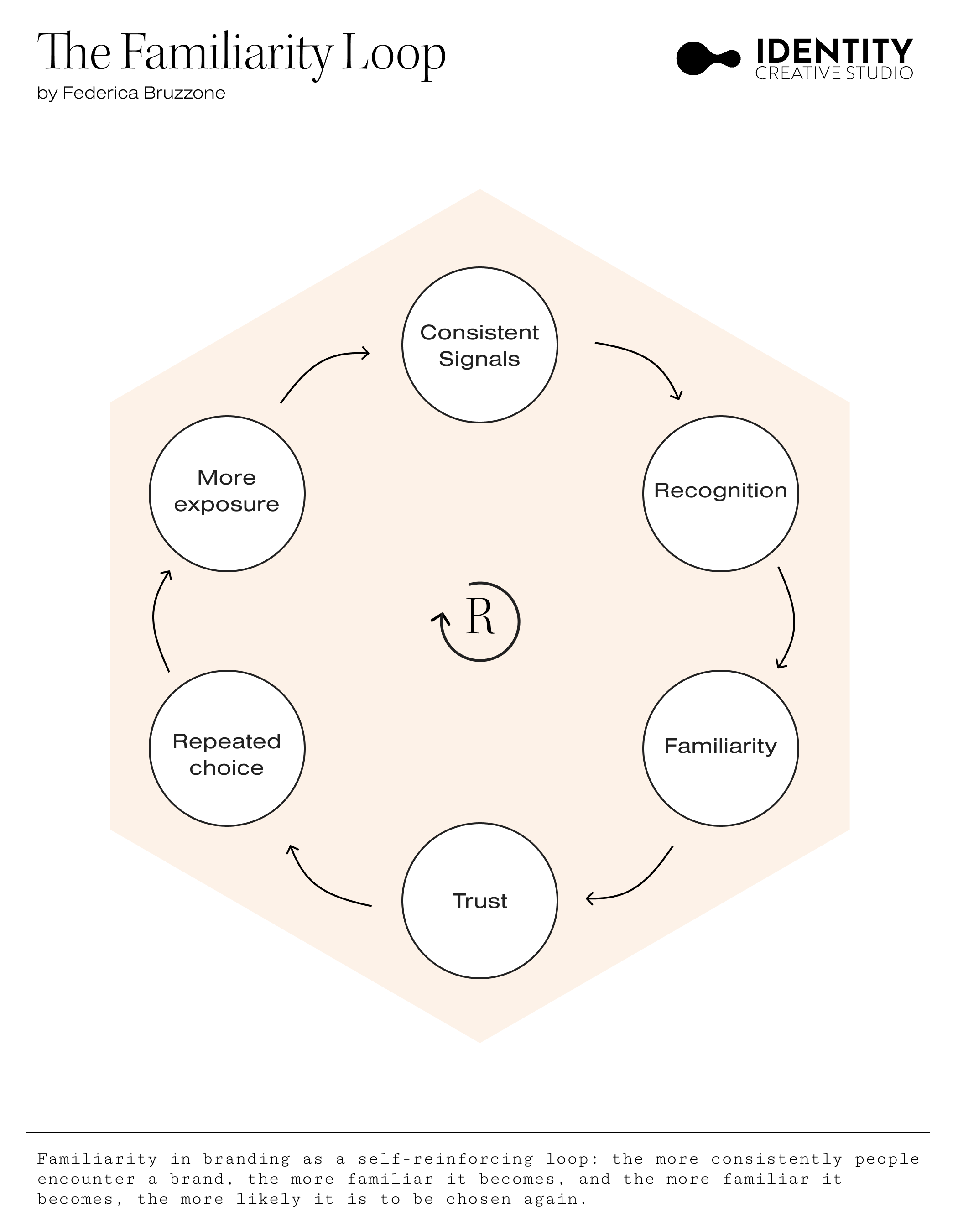
Each of these elements sends signals to the brain, and when these signals are consistent, the brain recognizes a pattern, which creates familiarity.
This is why consistency is one of the most powerful, if not the number one force in branding. And incredibly, it is often underestimated!!!
When every touchpoint reinforces the same narrative, tone, aesthetic, and meaning, familiarity starts to build.
Design elements, distinctive colors, symbols, typography, and tone of voice can become distinctive brand assets, helping audiences recognize the brand instantly.
But the most important layer is the narrative itself.
A clear narrative acts as the red thread that connects every interaction with the brand. Without this thread, touchpoints become fragmented, which creates confusion rather than familiarity.
Over time, familiarity builds trust, what shapes purchasing behaviour. According to Oberlo’s data, around 81% of shoppers say that trust is a decisive factor before committing to a purchase. But trust almost never comes from a single interaction; it develops gradually, through repeated exposure and consistent experiences, which create familiarity and a sense of comfort and, consequently, allow the brain to interpret the brand as known, predictable, and therefore safe to choose.
When consumers feel at ease with a brand, they tend to return to it again and again. What begins as simple recognition slowly transforms into preference, and that preference, over time, becomes loyalty.
Familiarity is Designed
That evening, watching the sunset, the feeling of familiarity appeared so easily. Nature does that sometimes, it reconnects us with patterns we have known forever.
Brands, however, cannot rely on chance: familiarity in branding is not accidental, but it is the result of carefully repeated signals, interpreted by the human brain over time.
And when those signals are aligned, when the narrative is clear and the ecosystem coherent, the brand stops feeling new and it starts feeling known.
And in a world full of noise, being known is often the first step to being chosen.
When you think about familiarity, what is the first thing that comes to mind?A place you return to? A person who feels like home? A brand you trust without thinking twice?I’m curious to hear what comes to mind for you 🧡